Your Next Customer May Never Visit Your Website. Their AI Will.
Buyers increasingly ask ChatGPT, Claude, and Perplexity what to purchase before they ever open a brand’s website. The AI reads your site on their behalf, compares you to competitors, and delivers a recommendation. That makes AI assistants the new first sales conversation, and most websites were never written for them.
How do people actually shop with AI?
Try buying a mattress right now.
Ten years ago you went to a showroom and an employee walked you through the options. Five years ago you read a dozen review sites and watched unboxing videos. Today, a growing number of buyers open ChatGPT and type something like:
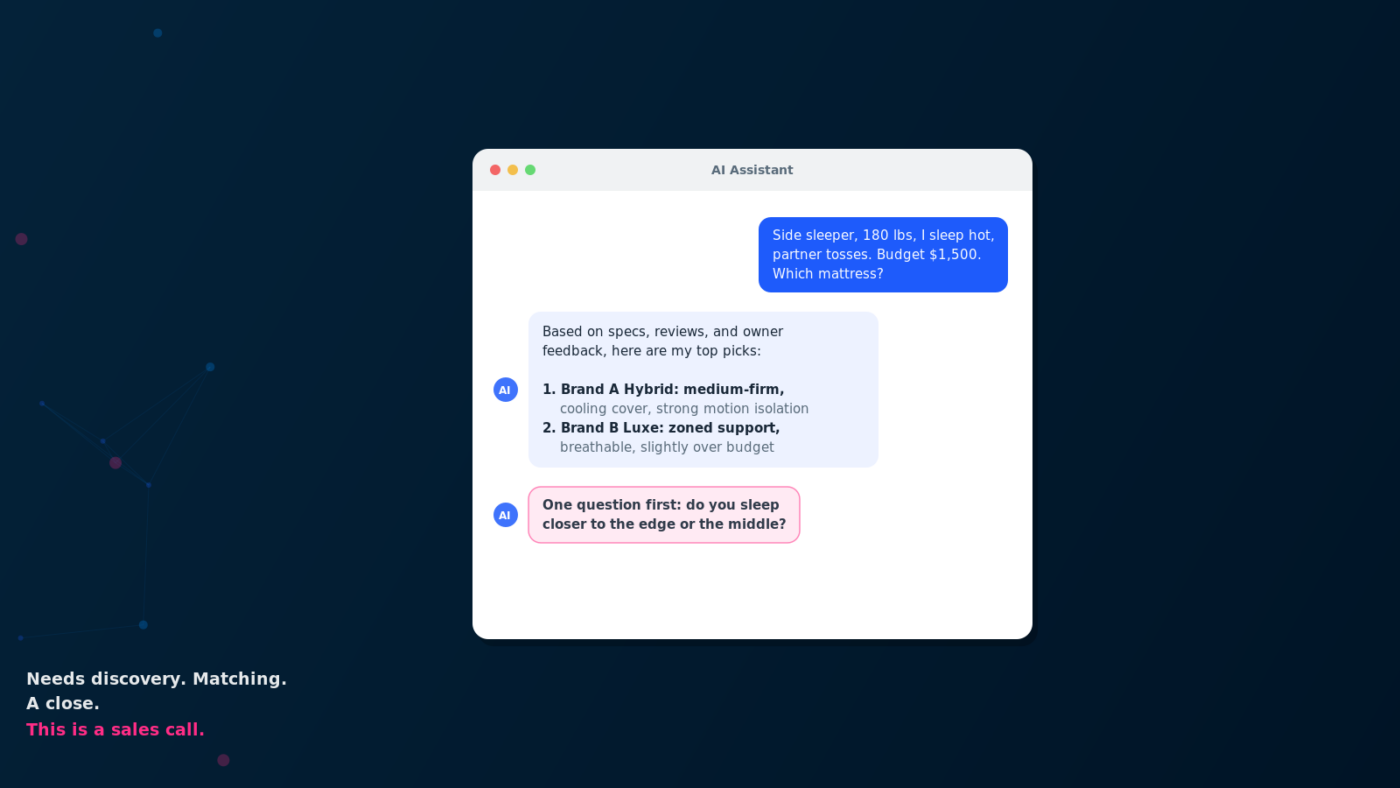
“I’m a side sleeper, about 180 pounds. I sleep hot. My partner tosses all night. Budget is $1,500. Which mattress should I buy?”
The AI goes shopping. It pulls manufacturer specs, professional reviews, community feedback, and structured product data from shopping feeds, maps it all against the buyer’s actual needs, and comes back with two or three specific recommendations. Then it does something a search engine never did: it asks a qualifying question. “How firm do you like it? Do you share the bed?” And it adjusts the recommendation based on the answer. That’s not a search result. That’s a sales conversation.
Notice what happened: the entire consideration phase, the part of the funnel your website was built to win, happened inside a chat window. Your beautiful homepage, your carefully sequenced product tour, your exit-intent popup. The buyer saw none of it.
And here’s the part most brands miss: the AI didn’t just read your website. It read everything downstream of your website. The review sites quoting your specs. The retailer product feeds carrying your data. The Reddit threads where owners describe your product in their own words. Your website is where all of that starts. It’s the source of truth that the whole ecosystem drinks from, including the AI.
Why do clear specs beat clever copy?
Here’s the part that should worry brands: the AI can only recommend what it can understand.
Mattress companies are a perfect example because the category invented its own marketing language. One brand’s product page leads with “adaptive cloud comfort technology.” Another lists “medium-firm, 6.5/10 firmness scale, graphite-infused cooling foam, motion isolation rated for couples.”
To a human skimming both pages, the first one might feel nicer. To an AI matching a side sleeper who sleeps hot against available products, the first page is close to invisible. There is nothing to grab. The second page answers the buyer’s question in the buyer’s terms, so the second mattress gets recommended. The first brand lost a sale it never knew was happening.
The damage compounds, because your published specs don’t stay on your site. Reviewers cite them. Retail feeds ingest them. Comparison sites tabulate them. When your source of truth is vague, everything downstream of it is vague too, and the AI synthesizing all of those sources has nothing solid to recommend. Clear specs propagate. Fog propagates too.
This is not a mattress problem. Run the same test on lawn mowers, CRM software, summer camps, or commercial insurance. The brands winning AI recommendations are the ones whose sites state plainly what the product is, who it fits, what it costs, and how it compares. The brands losing are the ones whose sites assume a human will linger long enough to decode the vibe.
Is your website training the AI correctly?
Think of every AI assistant as a salesperson you never hired and cannot script. It represents your products in conversations you will never see. The only influence you have is what you feed it: your website, your product data, and what the rest of the internet says about you.
So the practical question is: what does the AI salesperson say about you today?
You can check in five minutes. Open ChatGPT or Claude and ask the questions your buyers ask. “Best [your category] for [your ideal customer].” “Is [your brand] good for [common use case]?” “[Your brand] vs [competitor], which should I pick?” Read what comes back. That is your AI sales pitch, as it exists right now, and it was assembled without your input.
If you like what you see, your site is doing its job. Most brands do not like what they see.
What makes a website legible to AI?
The fixes are less exotic than you might expect. In our audits, the same items come up over and over:
Say what you are, in plain sentences. AI needs the words on the page. “The Dusk is a medium-firm hybrid mattress for combination sleepers” beats a hero video every time.
Answer real buyer questions on the page. FAQ sections are the single most liftable format for AI assistants. If your buyers always ask whether it works for X, write that question down and answer it.
Use specifics, not superlatives. Numbers, dimensions, compatibility, price ranges. “Industry-leading comfort” gives an AI nothing to work with.
Make sure AI can read your site at all. Many sites unknowingly block AI crawlers in robots.txt, or render content in JavaScript that crawlers never execute. Invisible is invisible.
Be present where AI cross-checks. Assistants weigh third-party sources heavily: Reddit threads, reviews, industry directories. A brand only described by itself is a brand an AI trusts less.
Get your product data into the shopping feeds. AI assistants increasingly surface products through structured merchant feeds (look at the URL parameters next time ChatGPT links you to a product; the feed integrations are right there). If you sell physical products and your data isn’t in those pipelines, you’re not in the conversation.
None of this replaces good branding for the humans who do visit. It is a second audience, reading the same pages, and right now almost nobody is writing for it.
The window is open
Here is the opportunity hiding in all of this: your competitors have not figured it out either. AI-assisted buying is growing fast, but the playbook for being recommendable is young. The brands that make themselves legible to AI in the next year or two get cited, recommended, and cross-referenced while everyone else is still optimizing for a search results page that fewer buyers see.
Your next customer is already asking. The only question is what the AI says back.
Freestyle Web Solutions is an AI consulting and automation practice in the San Francisco Bay Area. We build workflow automation, AI agents, data dashboards, and websites built to be understood by humans and the AI reading on their behalf. Want to know what AI says about your business? Ask us for an AI readability audit.
FAQ’s
Yes, and the share is growing fast. Buyers use AI assistants to research high-consideration purchases like mattresses, appliances, software, and services. The assistant reads brand websites and third-party sources, then recommends specific products, often before the buyer visits a single site.
Ask it directly. Prompt ChatGPT, Claude, and Perplexity with the questions your buyers ask, like “best [category] for [customer type]” and “[your brand] vs [competitor].” The answers show you exactly how AI represents your products today. Screenshot them; they’re your baseline.
It’s a review of how well AI assistants can find, understand, and recommend your products. We test what the major assistants currently say about your brand, audit your site’s content structure, crawler access, and product data clarity, and deliver a prioritized fix list. The goal: when a customer’s AI tours your site, it recommends you.