AEO, or Answer Engine Optimization, is the practice of making your website easy for AI assistants to read, quote, and recommend. When someone asks ChatGPT, Claude, Perplexity, or Gemini a question your business answers, AEO determines whether the assistant cites you, names a competitor, or repeats whatever a third-party ranking said about your category. It is the successor discipline to SEO for a world where the first page of results is a paragraph, not a list of links. If you are wondering how this fits with the SEO you already do, we keep a full comparison at the difference between AEO and SEO.
We have tested this directly, running identical buyer questions against multiple assistants in controlled sessions and recording every company they named and every source they cited. Three retrieval modes showed up, and only one of them is under your
Mode one: the assistant reads your pages. On specific questions, "who handles X for companies like mine," assistants fetch and quote the company's own site. This is where AEO pays. The pattern we observed repeatedly: the page that gets cited is the one that answers the exact question asked, often with a URL that restates the question. A firm with a dedicated page on its specialty got recommended over larger competitors that buried the same capability in a services list.
Mode two: the assistant reads about you. On superlative questions, "best X" and "top X," assistants lean on third-party listicles, broker sites, and industry roundups. You cannot write your way into someone else's listicle. Structure on your own site does not decide this mode; being written about does.
Mode three: the assistant reads nothing. Some answers come from the model's training memory, with no live sources at all. Brand recognition built over years decides this mode, and no on-page change moves it this quarter.
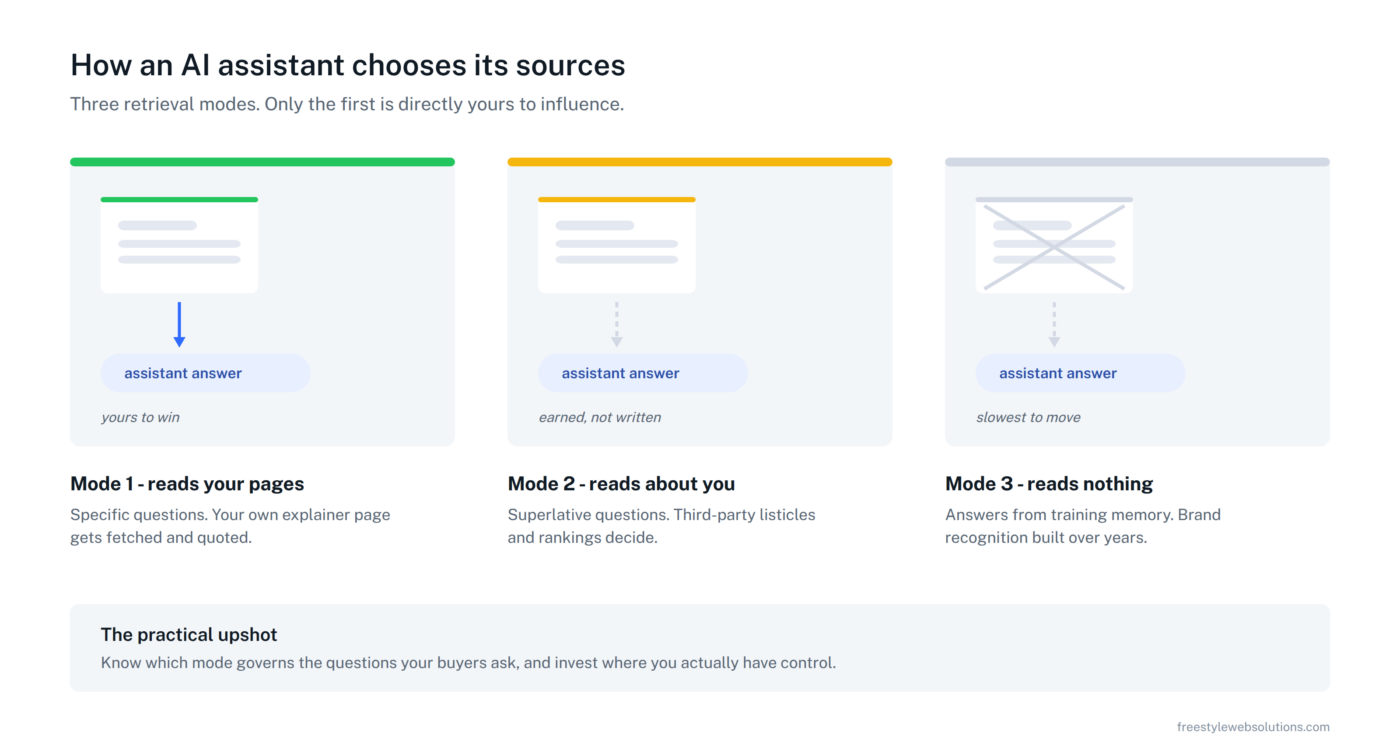
The practical upshot: AEO is not one lever. It is knowing which mode governs the questions your buyers ask, and investing where you actually have control.
Four things, in order of certainty.
Let the retrieval crawlers in. AI assistants use two kinds of crawlers: training crawlers that teach future models, and retrieval crawlers such as ChatGPT-User, Claude-User, OAI-SearchBot, and Perplexity-User that fetch your pages mid-conversation to answer a live question. Blocking a training crawler is a legitimate rights decision. Blocking a retrieval crawler silently removes you from answers, and many sites do it by accident through template defaults or CDN settings. This is the single most mechanical, verifiable fix in AEO.
Get the structural floor right. Answer-first openings an assistant can quote whole, headings phrased the way people actually ask, FAQ markup, clear entity information about who you are. This is hygiene: it makes your pages liftable when an assistant arrives. Our research is direct on the limits here, and honest vendors should be too: structural quality is a floor, not a ladder. A well-structured site is quotable; that alone does not make it chosen.
Own the page that answers the specific question. This is the strongest pattern in our data. Pick the question your buyers ask right before they ask who to hire. Not "best provider," but the real, specific question. Publish the definitive page on it, with the question in the title and the URL. Assistants answering that question reach for that page, and we have watched small firms beat household names on exactly this move.
Publish the numbers buyers need. Assistants build recommendations around concrete, quotable facts, and pricing is the clearest case we observed: the one provider in a category that published transparent pricing got quoted, calculated with, and recommended first, in multiple sessions, on the strength of a number nobody else made available.
Chasing a single "AI visibility score" as if it were a ranking. We built a scoring tool ourselves, so we tested the claim behind that whole product category in pre-registered research across more than a hundred firms in two industries. Here is what we found. The short version: scores measure readiness, not results. Anyone selling a number that supposedly predicts whether assistants will recommend you is selling past what the evidence supports, including us, which is why we do not.
Also on the does-not-work list: keyword stuffing reborn as "prompt stuffing," blocking competitors' crawlers, and treating one assistant's answer as the truth. In our testing, two major assistants asked identical questions agreed on barely a quarter of the companies they named, and the same assistant gave materially different answers in back-to-back sessions. Measure more than once, on more than one assistant, before believing any result, good or bad.
Our AI Visibility WordPress plugin logs which AI crawlers actually read your site, separates training visits from live-answer retrievals, verifies nothing is blocking them, and scores every page on the structural floor. The measurement loop around it is manual by design: real buyer questions, clean sessions, multiple assistants, recorded over time. If you want the honest version of this discipline instead of a dashboard number, that is the engagement.
Key Takeaways
Freestyle Web Solutions is an AI consulting and automation practice in the San Francisco Bay Area. We build workflow automation, AI agents, data dashboards, and websites for organizations that have outgrown their manual processes.
Answer Engine Optimization: making a website easy for AI assistants such as ChatGPT, Claude, Perplexity, and Gemini to read, quote, and recommend when they answer questions.
No. They overlap heavily, and most SEO fundamentals carry over. See our companion page, What is the difference between AEO and SEO, for exactly what transfers and what is new.
No. They overlap heavily, and most SEO fundamentals carry over. See our companion page, What is the difference between AEO and SEO, for exactly what transfers and what is new.
Crawler-access fixes take effect as soon as assistants next fetch your site, often within days. Content and page-ownership work compounds over weeks to months, and answers vary between assistants and even between sessions, so measure trends, not single checks.
No, and be wary of anyone selling one. Our own pre-registered research found that structural scores measure whether your pages are quotable, not whether assistants will choose you. The score is a floor to clear, not a rank to climb.